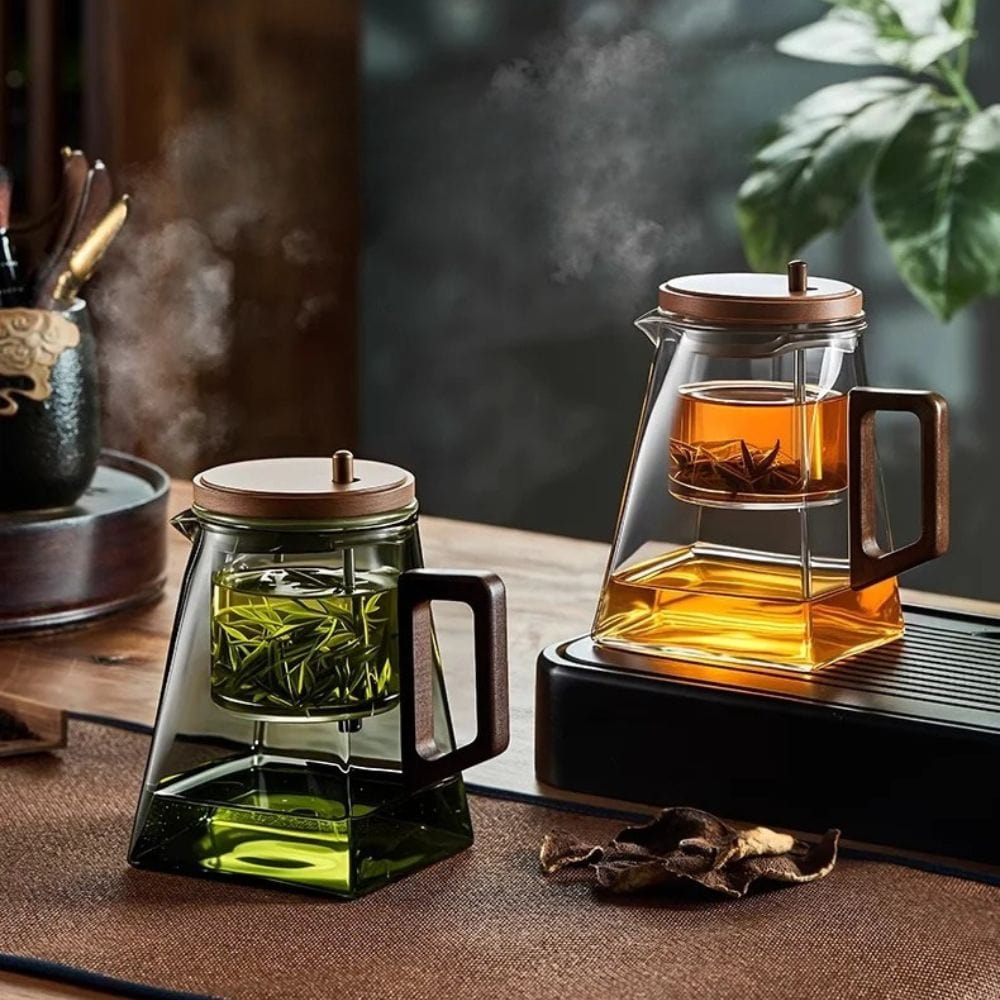


Japanese Tea Set: Complete Guide (Kyusu, Yunomi, Traditions)
Introduction: The Art of Japanese Tea
The Japanese tea set embodies centuries of refinement and philosophy. Far more than a simple collection of utensils, it reflects the wabi-sabi aesthetic, respect for nature, and the pursuit of harmony in every gesture.
From the traditional Tokoname clay kyusu to elegant porcelain sets, Japanese tea sets come in many forms, each suited to a particular type of tea and occasion. Choosing your tea set is also choosing a way of experiencing tea.
Discover everything you need to know about Japanese tea sets: traditional styles, materials, composition, and selection criteria. The complete guide to creating your Japanese tea ritual! 🎌🍵

-30% automatic by clicking below
Porcelain • Teapot + 2 cups • Lucky cat 🐱
📖 Table of Contents
1. The Tradition of Tea in Japan
Tea arrived in Japan from China in the 9th century, but it was in the 16th century that the tea ceremony (茶道, Chadō or Sadō) was codified by master Sen no Rikyū. This tradition profoundly influenced the design of Japanese tea sets.
🍃 The Four Principles of Japanese Tea
Sen no Rikyū defined four fundamental principles: Wa (和, harmony), Kei (敬, respect), Sei (清, purity), and Jaku (寂, serenity). These values are reflected in every element of the tea set – from the shape of the teapot to the texture of the cups.
🎌 Two Paths of Tea in Japan
- Chadō (茶道): The ceremonial path of matcha, with specific utensils (chawan, chasen, chashaku)
- Senchado (煎茶道): The path of infused tea (sencha, gyokuro), with kyusu and yunomi
The "daily" Japanese tea set generally belongs to the Senchado tradition, which is more accessible and widespread in modern Japan.
💡 Wabi-Sabi: The Beauty of Imperfection
The wabi-sabi aesthetic is at the heart of Japanese tea craftsmanship. It celebrates the beauty of simple, imperfect objects marked by time. An authentic Japanese tea set does not need to be perfect – its irregularities are its qualities.
To learn more, consult our guide on the Japanese tea ceremony.
2. Japanese Teapot Styles
Japan has developed several teapot styles, each suited for a particular use:
Kyusu (急須)
Side-handled teapot. The most common. Ideal for sencha and gyokuro. 150-400ml.
Tetsubin (鉄瓶)
Cast iron kettle. For heating water. Enriches with iron. Traditional and robust.
Houhin (宝瓶)
No handle. For very fine teas (gyokuro). Small capacity. Low temperature water.
Shiboridashi (絞り出し)
Very flat, no filter. For premium teas. Minimalist and elegant.
| Style | Handle | Capacity | Recommended Teas | Special Feature |
|---|---|---|---|---|
| Kyusu | Side | 150-400ml | Sencha, Bancha, Hojicha | Most versatile |
| Yokode Kyusu | Right side | 200-350ml | Sencha, Fukamushi | Classic Japanese |
| Ushirode Kyusu | Back | 300-500ml | Bancha, Hojicha | Adapted Chinese style |
| Houhin | None | 80-150ml | Gyokuro, Kabusecha | Warm water only |
| Shiboridashi | None | 50-100ml | Premium Gyokuro | Precise infusion |
| Dobin | Top handle | 500ml+ | Bancha, everyday teas | Large quantities |
🫖 The Kyusu: The Soul of the Japanese Tea Set
The kyusu (急須) is Japan's iconic teapot. Its side handle, perpendicular to the spout, allows for smooth, one-handed pouring. The act of pouring becomes natural and elegant. It is the ideal teapot for beginners in Japanese tea.

-30% automatic by clicking below
Artisan stoneware • Wide handle • Unique enamel 🏺
3. Traditional Materials
Japanese tea sets use a variety of materials, each with its own properties:
🏺 Tokoname (常滑)
Red clay from Tokoname. Softens the bitterness of tea thanks to iron. Ideal for sencha. The Japanese benchmark.
⚫ Cast Iron (Tetsu)
Internally enameled cast iron. Excellent heat retention. Traditional and robust. For kettle or teapot.
🪨 Stoneware (Sekki)
High temperature. Resistant and natural. Bizen, Shigaraki, Mashiko – each region has its style.
🤍 Porcelain (Jiki)
Fine and elegant. Arita, Hasami, Kutani. Traditional decorations. Does not alter taste.
🔮 Glass (Garasu)
Modern and transparent. See the infusion. Durable borosilicate glass. For visual teas.
🪵 Lacquered Wood (Shikki)
Trays and accessories. Traditional urushi lacquer. Elegance and protection.
🏺 Tokoname: The Holy Grail of Kyusu
Tokoname clay (Aichi Prefecture) is considered the best for Japanese teapots. Rich in iron and minerals, it chemically interacts with the tea to soften bitterness and round out flavors. An authentic Tokoname kyusu "seasons" over time, improving each infusion.
⚫ Tetsubin vs. Cast Iron Kyusu
- Tetsubin (鉄瓶): Unenameled cast iron kettle. For heating water only. Enriches water with iron.
- Tetsu-Kyusu: Enameled cast iron teapot. For infusing tea. Does not rust but does not enrich with iron.
Be careful not to confuse them: a traditional tetsubin should not be used for direct infusion!
To learn more, consult our guides on Japanese teapots and cast iron teapots.
4. Composition of a Japanese Tea Set
A traditional Japanese tea set includes several elements:
🫖 Essential Elements
- Kyusu (急須): The teapot, heart of the set
- Yunomi (湯呑み): Cylindrical, handleless tea cups
- Yuzamashi (湯冷まし): Water cooling vessel
- Chasen (茶筅): Matcha whisk (for Chadō)
- Chawan (茶碗): Matcha bowl (for Chadō)
📦 Complementary Accessories
- Chataku (茶托): Saucers for yunomi
- Chabon (茶盆): Serving tray
- Chadutsu/Chazutsu (茶筒): Tea caddy
- Chashaku (茶杓): Tea scoop (bamboo)
- Chakin (茶巾): Tea cloth
- Tetsubin (鉄瓶): Cast iron kettle
💡 Minimal Set to Start
To begin, you only need three elements: a quality kyusu, two or three matching yunomi, and ideally a yuzamashi to control the water temperature. You can enrich your collection over time.
5. Which Tea Set for Which Tea?
Each type of Japanese tea flourishes differently depending on the tea set used:
| Tea | Ideal Teapot | Material | Temperature | Cups |
|---|---|---|---|---|
| Gyokuro | Houhin, Shiboridashi | Porcelain, Tokoname | 50-60°C | Small (30-50ml) |
| Superior Sencha | Small Kyusu | Tokoname | 60-70°C | Medium (80-100ml) |
| Standard Sencha | Kyusu | Tokoname, stoneware | 70-80°C | Medium (100-150ml) |
| Fukamushi | Kyusu with fine filter | Tokoname | 70-80°C | Medium |
| Bancha | Kyusu, Dobin | Stoneware, ceramic | 80-90°C | Large (150-200ml) |
| Hojicha | Kyusu, Dobin | Stoneware, cast iron | 90-100°C | Large |
| Genmaicha | Kyusu | Any material | 80-90°C | Medium to large |
| Matcha | Chawan (bowl) | Ceramic, raku | 70-80°C | Single bowl |
⚠️ The Importance of Temperature
Japanese green tea is very sensitive to temperature. Water that is too hot makes the tea bitter and destroys its delicate aromas. The yuzamashi (cooler) is essential: each transfer from one vessel to another lowers the temperature by approximately 10°C.
To learn more, consult our guide on green tea.
6. How to Choose Your Tea Set Wisely
Here are the essential criteria for choosing your Japanese tea set:
📋 The 7 Selection Criteria
- Usage: Daily (versatile) or ceremonial (specialized)
- Tea type: Sencha (kyusu), Gyokuro (houhin), Matcha (chawan)
- Material: Tokoname for purists, porcelain for beginners, cast iron for robustness
- Capacity: 150-250ml for 1-2 people, 300-400ml for a family
- Filter: Integrated (ceramic) or removable (stainless steel) – crucial for fukamushi
- Number of cups: Minimum 2, often sold in pairs
- Aesthetics: Traditional rustic or modern minimalist
🎯 Our Recommendations by Profile
- Beginner: Porcelain kyusu + 2 yunomi, versatile and easy
- Sencha enthusiast: Tokoname kyusu + yuzamashi + matching yunomi
- Gyokuro purist: Houhin or shiboridashi + small cups
- Matcha fan: Chawan + chasen + chashaku + furui
- Family: Large kyusu or dobin + 4-6 yunomi
- Travel: Compact portable ceramic set with pouch
To create a harmonious set, consult our guide Tea Set: Complete Guide.

-30% automatic by clicking below
Handcrafted stoneware • Traditional style • Wabi-sabi 🍵
7. The Art of Serving Tea
Japanese tea service follows precise gestures that optimize the infusion:
🍵 Steps for Japanese Tea Service
- Heat the utensils: Pour hot water into the kyusu and cups, then empty
- Cool the water: Pour boiling water into the yuzamashi (drops ~10°C)
- Measure the tea: About 3-4g per person (1 heaped spoon)
- Infuse: Pour the cooled water, wait 60-90 seconds (depending on the tea)
- Serve alternately: Pour a little into each cup, then return – equalizes concentration
- Empty completely: Do not leave water in the kyusu for subsequent infusions
💡 The Secret to Multiple Infusions
Quality Japanese tea can be infused 2 to 3 times. Each infusion reveals different flavors: the first is the most intense, the second the most balanced, the third the mildest. Slightly increase the temperature and reduce the time for each successive infusion.
✅ The Right Gestures
- Holding the kyusu: Thumb on the lid, hand on the handle, fluid motion
- Serving: Alternate between cups to equalize concentration
- Last drops: The most concentrated, not to be neglected
- Presenting: Turn the cup so the best side faces the guest
8. Care and Precautions
A well-maintained Japanese tea set lasts for generations:
✅ Good Practices
- Immediate rinsing: Rinse with hot water after each use
- No soap: Especially for Tokoname and unglazed stoneware
- Open drying: Let dry with the lid removed to prevent mold
- Dry storage: In an airy place, away from humidity
- Gentle handling: Spouts and lids are fragile
🧹 Specific Maintenance by Material
- Tokoname: Hot water only, develops a desirable patina
- Porcelain: Can withstand a little mild soap if rinsed well
- Enameled cast iron: Dry immediately to prevent external rust
- Unglazed stoneware: Like Tokoname, water only, patina welcome
⚠️ What to Avoid
Never put a traditional Japanese tea set in the dishwasher. Avoid thermal shocks (boiling water in a cold vessel). Do not scrub unglazed surfaces with abrasive sponges. Tea patina is not dirt!
For more tips, consult our guide How to clean your teapot.
9. Frequently Asked Questions
❓ Why do Japanese cups not have handles?
Yunomi are designed to be held with two hands. This allows you to feel the temperature of the tea (a sign it's ready to drink) and creates a tactile connection with the beverage. Moreover, Japanese tea is drunk at a moderate temperature, so there's less risk of burning.
❓ What size kyusu should I choose?
For 1-2 people: 150-250ml. For 3-4 people: 300-400ml. Bigger isn't better – a kyusu too large for your use cools too quickly and complicates dosage. It's better to do several infusions than one large one.
❓ Can I use a kyusu for other teas?
Yes, but with caution. A porcelain or glazed stoneware kyusu is versatile. An unglazed Tokoname kyusu absorbs aromas: it's better to dedicate it to Japanese green teas. For flavored teas or oolong, use another vessel.
❓ Should the tea set be preheated?
Yes, it is highly recommended. Preheating the kyusu and cups with hot water helps to maintain the infusion temperature and achieve optimal extraction. This is particularly important for gyokuro served at low temperatures.
❓ How to recognize a genuine Tokoname?
Tokoname clay has a characteristic red-brown color (shudei). The kyusu is generally unglazed internally. Authentic pieces often bear the potter's seal. The quality of the integrated filter (sasame) is a good indicator of craftsmanship.
Conclusion: The Art of Living Japanese Tea
The Japanese tea set is much more than a collection of utensils – it's an invitation to meditation, slowing down, and appreciating simple things. Every element has been designed to enhance the tea experience.
📝 Key Takeaways
- 🫖 Flagship teapot: The side-handled kyusu, emblem of Japanese tea
- 🏺 King material: Tokoname for purists, porcelain for beginners
- 🍵 Cups: Handleless yunomi, to be held with two hands
- 🌡️ Temperature: Crucial! Use a yuzamashi to cool the water
- 🎌 Styles: Kyusu, Houhin, Shiboridashi – each with its own use
- 🧹 Care: Hot water only, no soap, open drying
- 💡 Tip: Start simple (kyusu + 2 yunomi) and gradually enrich your collection
Explore our tea set collection to find your ideal Japanese set, and discover our Japanese teapots!
To complete your ritual, consult our guides on stoneware cups and ceramic cups.
The Japanese tea set: where every gesture becomes a ceremony. 🎌🍵✨
🎌 Discover Our Japanese Tea Sets
Traditional Kyusu, complete sets, handcrafted cups... Find the perfect set for your tea ritual.
-30% with code BLOG30 • Free shipping
