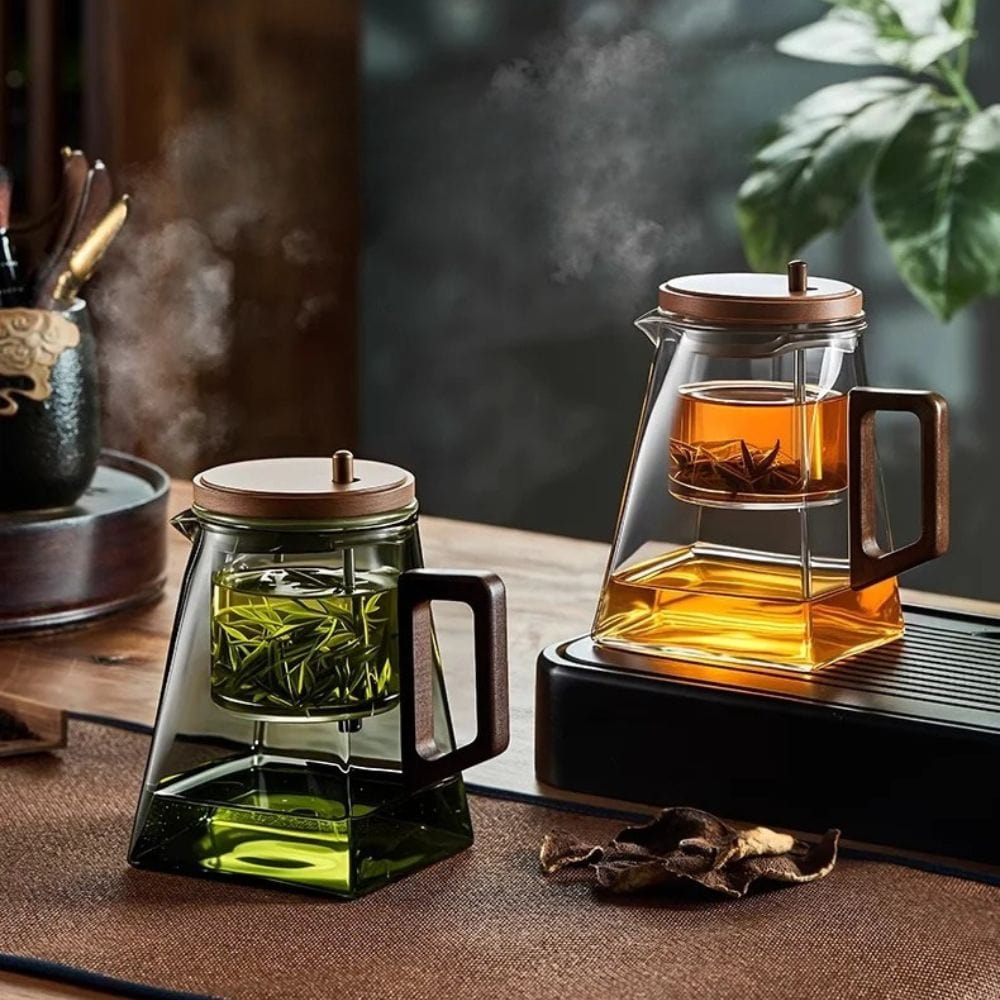


Double Wall Teapot: The Complete Guide
Introduction: The Double-Walled Teapot, Innovation in Service of Tea
The double-walled teapot represents one of the most practical innovations in the world of tea. This technology, made from high-quality borosilicate glass, offers a unique tasting experience: your tea stays hot longer, while the outside of the teapot remains perfectly handleable with bare hands.
Beyond its practical aspect, the double-walled teapot offers a fascinating visual spectacle. The tea seems to float in the air, the leaves dance in the water, and the colors of the infusion are magnified by this sleek design. It's the perfect fusion of science and aesthetics.
Discover everything you need to know about the double-walled teapot: how it works, its advantages, how to choose and maintain it. 🔮🫖

-30% automatic by clicking below
Glass & stainless steel • Large capacity ✨
📖 Table of Contents
- 1. How the Double Wall Works
- 2. Advantages of the Double-Walled Teapot
- 3. Borosilicate Glass: The Ideal Material
- 4. Different Types of Double Walls
- 5. How to Choose Your Double-Walled Teapot
- 6. Which Teas for a Double-Walled Teapot
- 7. Care and Precautions
- 8. Double Wall vs. Single Wall: Comparison
- 9. Frequently Asked Questions
- Conclusion
1. How the Double Wall Works
The principle of the double wall is simple yet ingenious: two layers of glass are separated by a thin layer of air (or partial vacuum). This intermediate layer acts as a natural thermal insulator.
🔬 Structure of the Double Wall
🌡️ The Principle of Insulation
The air trapped between the two walls is a poor heat conductor. It significantly slows down heat transfer between the hot liquid inside and the external environment. Result: the tea stays hot longer, and the external surface remains lukewarm or even cold.
🔮 How It's Made
- Glass Blowing: Two glass shapes are blown separately
- Assembly: The inner shape is inserted into the outer shape
- Sealing: The two walls are fused at the opening
- Small Hole: A tiny orifice allows pressure equalization (often at the bottom)
💡 The Small Hole at the Bottom
You will often notice a small hole at the bottom of double-walled glasses and teapots. This is not a defect! This hole allows pressure to equalize between the trapped air and the outside during temperature variations, thus preventing the glass from cracking.
2. Advantages of the Double-Walled Teapot
THERMAL INSULATION
Tea stays hot 2x longer
COMFORT
Exterior cool to the touch
AESTHETICS
Unique "floating tea" effect
ANTI-CONDENSATION
No drips on the table
✅ Detailed Advantages
- Better heat retention: Tea stays at ideal temperature 30-50% longer
- Safety: No risk of burns when handling the teapot
- No coaster needed: The outer surface does not heat the table
- Modern design: The visual effect is spectacular and contemporary
- Versatility: Works equally well for hot and cold beverages
- Lightness: Despite two walls, borosilicate glass remains lightweight
❄️ Bonus: Ideal for Cold Drinks
The insulation works both ways! For iced tea or cold infusions, the double wall prevents condensation from forming on the outside. No more water rings on the table and wet hands!
Discover our selection of tea cups including double-walled models.
3. Borosilicate Glass: The Ideal Material
Quality double-walled teapots are made of borosilicate glass, a technical glass with exceptional properties.
🧪 What is Borosilicate Glass?
Invented at the end of the 19th century, borosilicate glass contains boron in its composition (approximately 13%). This characteristic gives it much higher thermal shock resistance than ordinary glass. It is the same glass used in laboratories and high-end kitchen utensils (like Pyrex).
✅ Properties of Borosilicate Glass
- Thermal resistance: Withstands temperature differences from -20°C to +150°C
- Neutrality: Does not absorb or transmit any taste or odor
- Transparency: Perfect clarity that does not tarnish over time
- Lightness: Lighter than classic glass of the same thickness
- Durability: Resistant to scratches and daily wear and tear
- Food safety: BPA-free, lead-free, cadmium-free
| Characteristic | Borosilicate Glass | Ordinary Glass |
|---|---|---|
| Thermal Resistance | Excellent ✅ | Average ⚠️ |
| Thermal Shock | Up to 150°C difference | ~50°C difference |
| Weight | Light | Heavier |
| Durability | Very good | Average |
| Price | Higher | Economical |
⚠️ Beware of Imitations
Some cheap teapots are sold as "double-walled" but use ordinary glass. They are less resistant to thermal shock and can crack. Always check that the product mentions "borosilicate glass".

-30% automatically by clicking below
With handle • Decorative dried flower 🌺
4. Different Types of Double-Walled Products
There are several variations of double-walled products for tea:
🫖 Double-Walled Teapots
- With integrated infuser: Removable glass or stainless steel filter
- Without infuser: For loose leaf teas with an external strainer
- With plunger: Press system like a French Press
- Capacities: Generally 400ml to 1.2L
☕ Double-Walled Cups and Mugs
- With handle: For a classic grip
- Without handle: Sleek design, perfect due to insulation
- With lid: To keep tea hot even longer
- With infuser: For steeping directly in the cup
- Capacities: From 80ml (espresso) to 650ml (large cup)
🍵 Double-Walled Glasses
- Straight shape: Classic and versatile
- Flared shape: To appreciate aromas
- Original shape: Heart, star, creative designs
- Use: Tea, coffee, cocktails, desserts
💡 Teapot or Cup?
For solo tasting, a large double-walled cup with an infuser (350-500ml) is ideal. For several people or multiple infusions, opt for a teapot (600ml-1L). Some tea sets sometimes include complete double-walled sets.
5. How to Choose Your Double-Walled Teapot
✅ Selection Criteria
- Material: Prefer certified borosilicate glass
- Capacity: 400-600ml for 1-2 people, 800ml+ for more
- Infuser: Glass (neutral) or stainless steel (durable)
- Handle: Integrated glass, wood, or silicone
- Spout: Drip-free preferably
- Compatibility: Some models are dishwasher-safe
| Use | Ideal Capacity | Recommended Type |
|---|---|---|
| Office / Solo | 300-450ml | Cup with infuser |
| Breakfast | 500-650ml | Large cup or small teapot |
| Couple | 600-800ml | Medium teapot |
| Family / Guests | 1L+ | Large teapot |
⚠️ Points to Watch Out For
Check the quality of the seals between the two walls: they must be perfectly airtight. Avoid models that are too fragile at the handle. Prefer reputable brands that guarantee their products.
For more advice, consult our guide How to choose your teapot.
6. Which Teas for a Double-Walled Teapot
The double-walled glass teapot is versatile and suitable for almost all types of tea. Its neutrality is its greatest asset.
✅ Ideal Teas for Double Wall
- Green teas: Perfect! Transparency allows observation of leaves
- White teas: Delicate color magnified by the glass
- Oolongs: Observe the opening of rolled leaves
- Flowering teas (blooming tea): Visual spectacle guaranteed!
- Fruit infusions: Vibrant colors enhanced
🌸 The Case of "Blooming Tea"
Flowering teas (or blooming teas) are tea balls that unfurl in water to reveal a flower. A transparent double-walled teapot is the PERFECT vessel for this spectacle. The insulation keeps the water hot throughout the "blooming" process (2-3 minutes).
💡 Black Teas and Pu-erh
Although glass is also suitable for black teas and Pu-erh, purists often prefer ceramic or clay (Yixing) for these teas, which benefit from a slight interaction with the material.
To know the correct temperatures, consult our guide on infusion temperature.

-30% automatically by clicking below
Integrated stainless steel filter • Versatile 🫖
7. Care and Precautions
✅ Daily Cleaning
- Rinse with lukewarm water after each use
- Use a soft sponge (non-abrasive)
- Air dry or use a soft cloth
- Do not leave tea to sit to avoid deposits
🧹 Deep Cleaning
For tannin deposits or limescale:
- Baking soda: 1 spoon + lukewarm water, let sit for 15 min
- White vinegar: 50/50 mix with water, rinse thoroughly
- Lemon: Rub with half a lemon, rinse
❌ Absolutely Avoid
Never: Go from cold to hot abruptly (even borosilicate has its limits). Do not use abrasive products or scratching sponges. Do not bump against hard surfaces. Do not microwave if metal is present (stainless steel infuser).
⚠️ Dishwasher: Caution
Some double-walled teapots are dishwasher-safe, others are not. Always check the manufacturer's instructions. When in doubt, hand washing remains the safest method to preserve the longevity of your teapot.
For more advice, consult our guide Teapot Care.
8. Double Wall vs Single Wall: Comparison
| Criterion | Double Wall | Single Wall |
|---|---|---|
| Thermal Insulation | ⭐⭐⭐⭐⭐ Excellent | ⭐⭐ Low |
| Comfort of grip | ⭐⭐⭐⭐⭐ Exterior cold | ⭐⭐ Can burn |
| Condensation | ⭐⭐⭐⭐⭐ None | ⭐⭐ Present (cold) |
| Visual effect | ⭐⭐⭐⭐⭐ Spectacular | ⭐⭐⭐ Standard |
| Price | ⭐⭐⭐ Higher | ⭐⭐⭐⭐⭐ Economical |
| Weight | ⭐⭐⭐⭐ Light | ⭐⭐⭐⭐⭐ Very light |
| Fragility | ⭐⭐⭐ Moderate | ⭐⭐⭐⭐ Low |
💡 When to Choose Double Wall?
Opt for double-wall if you: drink your tea slowly, want a designer object, seek comfort without a handle, regularly serve iced tea, or want to avoid coasters. The price difference is quickly paid off by the pleasure of use.
9. Frequently Asked Questions
❓ Does the double wall really keep tea hot longer?
Yes, significantly. Tests show that a double-walled teapot keeps tea at a good temperature approximately 30 to 50% longer than a single-walled teapot. For tea poured at 80°C, allow about 20-30 minutes more before it becomes lukewarm.
❓ Can boiling water be put in a double-walled teapot?
Yes, if it's made of borosilicate glass. This glass is designed to withstand thermal shock. You can pour boiling water without a problem. Just avoid transferring the teapot directly from the freezer to boiling water (extreme thermal shock).
❓ How do I know if my teapot is really borosilicate?
Check the markings on the packaging: "borosilicate glass", "verre borosilicate", "heat-resistant glass". Quality products clearly indicate this. When in doubt, ask the seller. The price is also an indicator: borosilicate costs more than ordinary glass.
❓ Is the small hole at the bottom a defect?
No, it's normal! This tiny hole allows air pressure to balance between the two walls during temperature changes. Without it, the pressure difference could cause the glass to crack. It's a sign of quality, not a defect.
❓ Can I use my double-walled teapot on a hot plate?
No, it's not recommended. Even with borosilicate, direct contact with a heat source (hot plate, flame) can create hot spots and crack the glass. To reheat your tea, transfer it or use a candle teapot warmer with caution.
Conclusion: The Double Wall, A Modern and Practical Choice
The double-walled teapot combines the best of innovation and aesthetics. It offers a superior tasting experience thanks to its thermal insulation, while transforming each infusion into a visual spectacle.
📝 Summary
- ✅ Insulation: Tea stays hot longer, exterior stays cool
- ✅ Material: Prefer borosilicate glass
- ✅ Versatility: Hot and cold, all types of tea
- ✅ Design: Spectacular "floating" effect
- ✅ Care: Simple, preferably by hand
- ⚠️ Caution: Avoid extreme thermal shocks
Whether you are a fan of Japanese tea, Chinese tea, or simply looking for a modern and practical teapot, the double wall is an excellent investment.
Explore our collection of teapots and find your ideal model!
Tea deserves to be as beautiful as it is delicious. The double wall offers both! 🔮🫖✨
🔮 Discover Our Double-Walled Teapots
Premium borosilicate glass, elegant designs, optimal insulation.
-30% with code BLOG30 • Free shipping
