

Tie Guan Yin: Complete Guide to the Iron Goddess
Introduction: The Iron Goddess of Mercy
Tie Guan Yin (鐵觀音, Tiě Guān Yīn) is undoubtedly the world's most famous Oolong tea. Its poetic name, "Iron Goddess of Mercy," evokes both its robustness and its legendary delicacy.
Originating from Anxi County in Fujian, China, this tea, with its jade-green rolled leaves, offers an enchanting orchid fragrance and an incomparable creamy sweetness. Discover the history, manufacturing secrets, and the art of tasting this jewel of Chinese tea. 🌸🐉

Automatic 30% off by clicking below
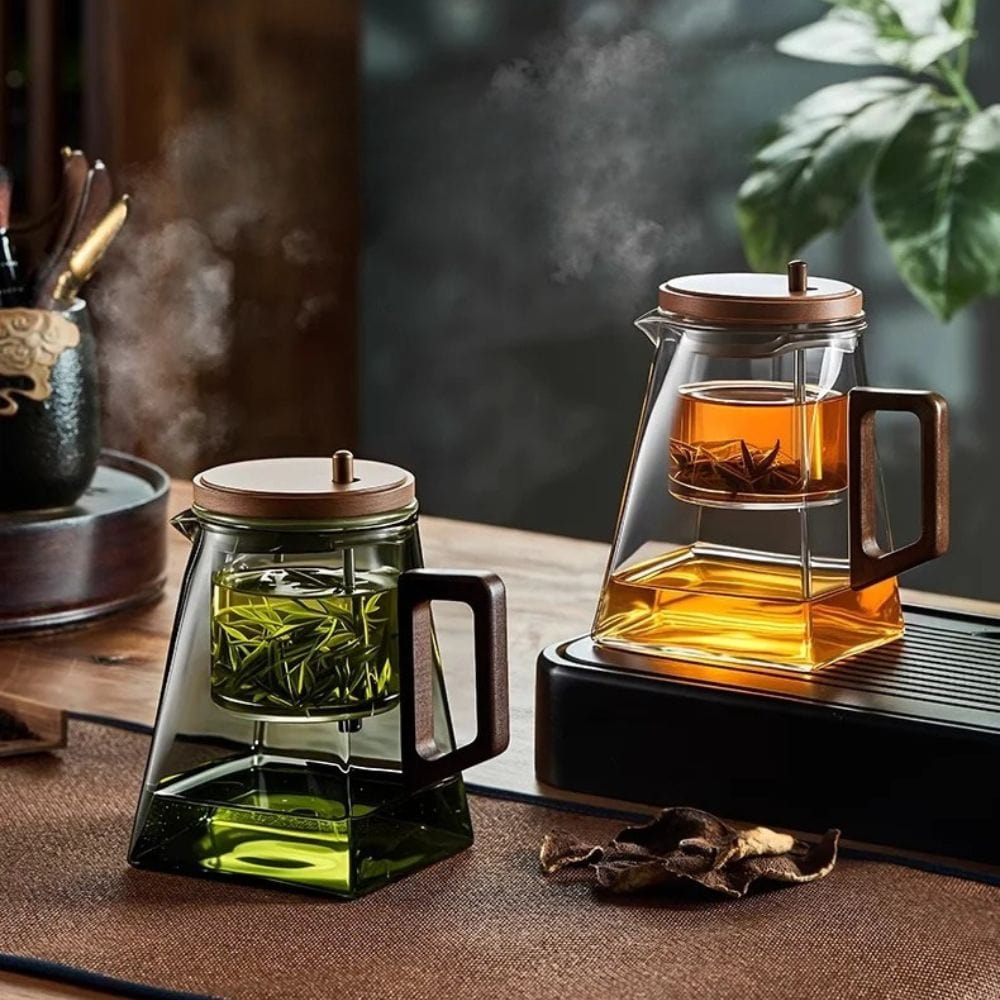
300ml • Removable filter • Ideal for Tie Guan Yin 🌸
📖 Table of Contents
1. What is Tie Guan Yin?
Tie Guan Yin is a semi-oxidized Oolong tea, considered one of China's ten great teas.
🌸 The King of Floral Oolongs
Tie Guan Yin gets its name from Guan Yin (觀音), the Buddhist goddess of mercy, and "Tie" (鐵, iron), referring to the density of the rolled leaves. It is a lightly to moderately oxidized (15-50%) Oolong tea, famous for its orchid fragrance, creamy texture, and its ability to be reinfused many times.
🌺 Orchid Fragrance
Signature floral aroma, enchanting and delicate.
💎 Jade Balls
Tightly rolled, bright green leaves.
🔄 7+ Infusions
Unfurls and reveals new facets.
🏆 Top 10 China
Among the ten great Chinese teas.
📋 Identity Card
- Chinese Name: 鐵觀音 (Tiě Guān Yīn)
- Meaning: "Iron Goddess of Mercy"
- Type: Oolong (semi-oxidized tea)
- Origin: Anxi County, Fujian, China
- Oxidation: 15-50% depending on style
- Cultivar: Tie Guan Yin (specific variety)
- Shape: Tightly rolled balls (蜻蜓頭, "dragonfly head")
- Liquor Color: Gold-green to amber depending on oxidation
2. The Legend of the Iron Goddess
Two main legends explain the origin of Tie Guan Yin:
📜 The Legend of Wei Yin (The Peasant's Version)
In the 18th century, a humble peasant named Wei Yin passed by an abandoned temple dedicated to Guan Yin every day. Saddened by its dilapidated state, he regularly cleaned it and burned incense there. One night, the goddess appeared to him in a dream and revealed the location of a treasure behind the temple. The next day, Wei discovered not gold, but an extraordinary tea plant. He cultivated it with devotion and named it in honor of the goddess who had guided him.
📜 The Legend of Wang Shiang (The Scholar's Version)
According to another version, a scholar named Wang Shiang discovered the tea plant under a rock shaped like Guan Yin. Impressed by the exceptional quality of the tea, he offered it to Emperor Qianlong who, captivated by its aroma, asked for its origin. Learning the story of the rock, the emperor named it "Tie Guan Yin" because of the density of the leaves (heavy like iron) and the shape of the rock (Guan Yin).
💡 Did you know?
The village of Xiping in Anxi County is considered the historical birthplace of Tie Guan Yin. Even today, Wei Yin's descendants cultivate this tea using traditional methods. A true Anxi Tie Guan Yin is a product of its terroir, like a great wine vintage.
3. The Terroir of Anxi
Anxi County is the only authentic terroir for Tie Guan Yin:
🏔️ Anxi: The Cradle of Tie Guan Yin
Located in Fujian province in southeastern China, Anxi County benefits from ideal conditions: altitude 500-1000m, humid subtropical climate, frequent mists, acidic soils rich in minerals. These unique conditions give Anxi Tie Guan Yin its inimitable character.
🌍 The Renowned Villages of Anxi
- Xiping (西坪): Historical birthplace, traditional style, original terroir
- Gande (感德): Popular modern style, very floral notes
- Xianghua (祥華): High altitude, pronounced freshness
- Longquan (龍涓): Balance between tradition and modernity
Important: A Tie Guan Yin that is not from Anxi is technically not a "true" Tie Guan Yin, even if it uses the same cultivar.
🍃 The Tie Guan Yin Cultivar
Tie Guan Yin is also the name of a specific cultivar (tea plant variety):
- Leaves: Thick, oval, serrated edge
- Characteristic: "Red monkey face" – young shoots have reddish highlights
- Aroma: Naturally floral and creamy
- Yield: Moderate, which explains its price
This cultivar can be planted elsewhere, but only the Anxi terroir gives it its optimal expression.

Automatic 30% off by clicking below
6 pieces • Teapot + cups • Gong Fu 🏺
4. Modern vs. Traditional Style
Tie Guan Yin comes in two main, very different styles:
Modern Style (Qing Xiang)
"Fresh Fragrance" – Developed in the 1990s
- Oxidation: Light (15-25%)
- Roasting: Minimal or none
- Leaf color: Bright jade green
- Liquor color: Pale golden-green
- Aromas: Intense orchid, white flowers, milky
- Taste: Fresh, lively, very floral
- Storage: Refrigerator recommended
Traditional Style (Nong Xiang)
"Rich Fragrance" – Ancestral method
- Oxidation: Medium (30-50%)
- Roasting: Light to medium
- Leaf color: Green-brown
- Liquor color: Amber gold
- Aromas: Honey, ripe fruits, toasted notes
- Taste: Complex, round, deep
- Storage: Room temperature, can age
| Criterion | Modern (Qing Xiang) | Traditional (Nong Xiang) |
|---|---|---|
| Oxidation | 15-25% | 30-50% |
| Roasting | None/light | Light to medium |
| Dominant aroma | Orchid, floral | Honey, toasted |
| Brewing temperature | 85-90°C | 90-95°C |
| Storage | Fridge (6-12 months) | Room temp (1-3 years) |
| For whom? | Green/floral tea lovers | Complexity lovers |
💡 Which Style to Choose?
Beginner? Start with the modern style (Qing Xiang), which is more accessible and immediately pleasant with its floral notes. Experienced enthusiast? Explore the traditional style (Nong Xiang) to discover the depth and complexity of authentic ancestral Tie Guan Yin.
🔥 Aged Tie Guan Yin (Chen Xiang)
There is a third category: aged Tie Guan Yin (陳香, Chen Xiang). These are traditional Tie Guan Yin stored and re-roasted for several years (5-30 years). The result is a tea with deep notes of dried fruits, prunes, and precious wood. Highly sought after by connoisseurs, it can reach high prices.
5. Traditional Production
The production of Tie Guan Yin is one of the most complex in the world of tea:
📋 Production Steps
- Plucking (采摘): 3-4 mature leaves, midday when dew has dried
- Sun-withering (晒青): 30-60 min to soften leaves
- Indoor-withering (凉青): Rest indoors, controlled temperature
- Shaking (摇青): 3-5 shaking cycles to initiate oxidation
- Oxidation (发酵): Controlled rest, the master monitors the aroma
- Fixation (杀青): Heat to stop oxidation
- Rolling (揉捻): Shaping into tight balls
- Drying/Roasting (烘焙): Final drying, roasting according to style
🌀 The Secret of Rolling
The rolling of Tie Guan Yin is unique. The leaves are wrapped in cloth and pressed/rolled by hand or machine, creating the famous "jade balls". This process is repeated many times (sometimes 30-50 cycles) until the characteristic tight shape is achieved. It is this intensive rolling that gives the leaves their "iron" density.
⚠️ The Importance of the Tea Master
Shaking (摇青) is the most critical step. The tea master must judge by sight, touch, and smell when the leaves have reached the perfect level of oxidation. Too little = flat tea. Too much = over-oxidized tea. This expertise is passed down from generation to generation and makes the difference between an ordinary Tie Guan Yin and a grand cru.
6. How to Prepare It
Tie Guan Yin reveals all its magic with careful preparation:
📋 Western Method (Simple)
- Dosage: 3-5g for 200ml
- Temperature: 85-95°C (depending on style)
- Time: 2-4 minutes
- Reinfusions: 2-3 possible
Tip: Don't overfill the infuser – the balls triple in volume as they open!
🫖 Gong Fu Method (Recommended)
The Gong Fu method reveals all the complexity of Tie Guan Yin:
- Dosage: 7-8g for a 100-120ml gaiwan
- Rinsing: Pour hot water, discard after 5 seconds (wakes up the leaves)
- 1st infusion: 20-30 seconds
- Subsequent infusions: +5-10 sec each time
- Number: 7-10 infusions possible
Observation: Watch the leaves gradually unfurl – it's a spectacle!
| Style | Temperature | Time (Gong Fu) | Time (Western) |
|---|---|---|---|
| Modern (Qing Xiang) | 85-90°C | 15-25 sec | 2-3 min |
| Traditional (Nong Xiang) | 90-95°C | 20-30 sec | 3-4 min |
| Aged (Chen Xiang) | 95-100°C | 25-35 sec | 4-5 min |
💡 Evolution Over Infusions
A good Tie Guan Yin evolves beautifully: 1st infusion = intense fragrance but light taste (leaves opening). 2nd-4th infusions = peak, perfect aroma/taste balance. 5th-7th infusions = sweetness, sugary notes, less fragrance. 8th+ infusions = soft and soothing finish. It's this journey that makes Gong Fu so captivating!

-30% automatic by clicking below
350ml • Elegant glass • Large capacity ✨
7. How to Recognize an Authentic Tie Guan Yin
The market is flooded with fake Tie Guan Yin. Here's how to identify the authentic one:
✅ Signs of a Real, Quality Tie Guan Yin
- Appearance: Tight, uniform balls, bright green (modern) or green-brown (traditional)
- Weight: Dense and heavy in hand ("iron")
- Dry fragrance: Delicate floral, no artificial fragrance
- Infused leaves: Whole, slightly red edges ("red fringe")
- Liquor: Clear, golden-green to amber depending on style
- Taste: "Guan Yin Yun" – the characteristic persistent floral aftertaste
- Re-infusions: At least 5-7 quality infusions
❌ Signs of a Fake or Bad Tie Guan Yin
- Too low price: A real Anxi TGY cannot cost €5/100g
- Artificial fragrance: Chemical or overly intense smell
- Broken leaves: Sign of poor quality or blend
- Dull color: Lack of freshness or poor storage
- Flat taste: No evolution over infusions
- Excessive bitterness: Poorly controlled oxidation or tea from a bad cultivar
- Vague origin: "China" without precision = suspicious
🔍 The Origin Test
A reputable seller should be able to tell you:
- The village of origin (Xiping, Gande, etc.)
- The harvest season (spring = best, autumn = very good too)
- The style (Qing Xiang or Nong Xiang)
- The production year
If the seller cannot answer these questions, be wary.
⚠️ Beware of Tie Guan Yin from Taiwan or Vietnam
The Tie Guan Yin cultivar is also planted in Taiwan, Vietnam, and elsewhere. These teas can be good, but they are not authentic Tie Guan Yin in the strict sense. A true Tie Guan Yin comes from Anxi, Fujian. The rest should be called "Tie Guan Yin style tea" or by the cultivar name.
8. Frequently Asked Questions
❓ Does Tie Guan Yin contain caffeine?
Yes, like all true teas. Tie Guan Yin contains about 30-50mg of caffeine per cup, less than coffee but enough for a stimulating effect. The modern style (less oxidized) tends to have a little more caffeine than the traditional. Avoid it after 5 PM if you are sensitive.
❓ How to store Tie Guan Yin?
Modern style (Qing Xiang): In the refrigerator in an airtight vacuum-sealed bag. Optimal duration: 6-12 months. Allow to return to room temperature before opening to avoid condensation. Traditional style (Nong Xiang): Room temperature in an airtight box. Can be stored for 1-3 years.
❓ What is the difference from other Oolongs?
Tie Guan Yin is distinguished by its unique orchid fragrance and its "Guan Yin Yun" (characteristic aftertaste). Compared to Da Hong Pao (mineral, roasted), it is more floral and lighter. Compared to Taiwanese Dong Ding, it is livelier and less buttery. Each Oolong has its own personality!
❓ Why does the price vary so much?
The price of a Tie Guan Yin depends on: the origin (authentic Anxi vs. others), the terroir (reputable village vs. generic), the quality of the cultivar, the master's expertise, the season (spring premium), and the style (traditional often more expensive). A good Anxi TGY costs a minimum of €15-25/100g, grand crus exceed €100/100g.
❓ Can Tie Guan Yin be drunk daily?
Absolutely! Tie Guan Yin is perfect for daily consumption. Its moderate caffeine content allows it to be drunk from morning to early afternoon. Chinese people consider it beneficial for digestion and general well-being. See also our slimming tea guide.
Conclusion: The Jewel of Fujian
Tie Guan Yin is much more than just a tea: it's a sensory experience, a cultural heritage, and a way of life. Whether you choose the modern style with its intoxicating orchid notes or the traditional style with its complex honey aromas, you'll discover why this tea has been revered for centuries.
📝 Key Takeaways
- 🌸 Name: "Iron Goddess of Mercy"
- 🏔️ Origin: Anxi, Fujian, China (only authentic terroir)
- 🌿 Modern style: 15-25% oxidized, floral, fresh, refrigeration storage
- 🏺 Traditional style: 30-50% oxidized, honeyed, complex
- 🌡️ Temperature: 85-95°C depending on style
- 🔄 Re-infusions: 7-10 in Gong Fu
- ✅ Quality: Tight balls, natural fragrance, whole leaves
Also discover our guides on Oolong tea, green tea, brewing temperature, and the Gong Fu Cha method.
Let yourself be enchanted by the Iron Goddess! 🌸🐉✨
🌸 Discover Our Tie Guan Yin Accessories
Gaiwans, cups, teapots... Everything to enhance your tasting!
-30% with code BLOG30 • Free shipping
